Showing posts with label Racing. Show all posts

McLaren MP4-12C GT3 Endurance Racer Coming in 2012


Twelve years after the last six McLaren F1 GTR “Longtails” hit the tarmac at Le Mans, the British supercar maker and CRS Racing have begun work on an MP4-12C-based GT3 racecar. According to the plan that was revealed today, the MP4-12C GT3 will be available in limited numbers starting from 2012.

The McLaren F1 GTR was a very successful racecar, taking the checkered flag at the 24 Hours of Le Mans on its debut, so the bar has been set pretty high for the new car. Nevertheless, featuring an advanced one-piece carbon fiber chassis and finely tuned aerodynamic body, the MP4-12C should provide an excellent starting point for the development of the race version.

“The 12C’s architecture and design was always aimed at high-performance and ease of maintenance - two key criteria for potential customers. Combine that with the vast amount of racing experience in our automotive team, and CRS Racing’s specialist development experience, and the 12C GT3 should be an exciting proposition for the top teams planning to race in GT3 from 2012”, said Martin Whitmarsh, Vodafone McLaren Mercedes Team Principal.

As part of the development process, McLaren and CRS Racing will enter 12C GT3 prototypes in select European GT races next year. Further details about the racing program are also going to be announced in 2011. Potential clients can register their interest at "www.mclarengt.com."

By Csaba Daradics


_______________________________PHOTO_______________________________


Lotus inspired Proton car


Proton, the Malaysian car company recently launched the Satria Neo R3 Lotus Racing edition. Meant to commemorate the Lotus Formula One racing team, the car wears the traditional Lotus green and yellow racing colours.


The car is powered by a retuned version of Proton's 1.6-litre CamPro CPS engine. Special features include the R3 Tuned Öhlins Coil-Overs Dampers and Öhlins DFV (Dual Flow Valve) technology. This 5 speed manual car has a maximum power of 145bhp at 7000 rpm and can go from 0-100Km/hour in 9.2 seconds.

The car is currently available at RM115,000 which is approximately around £23K. So far, there is no news of it being exported to the UK.

Technology that powers the Lotus Racing team

Mia Sharizman Bin Ismail, Head of Operations (Asia) of Lotus Racing talks about the growth and opportunities for Malaysians in the ICT sector and in developing a k-economy. I have taken part of the interview that relate to the F1 races.

(From L-R) Mia Sharizman Ismail,Head of Operations (Asia), Riad Asmat, Chief Executive Officer of Lotus Racing, and Alex Yoong (former F1 driver).

How important is the role of Information and Communications Technologies (ICT) solutions in Formula 1?

Mia: ICT is definitely crucial in F1. Firstly, as a communication tool. The entire team must be in constant communication, whether it be in the factory, on the circuit, in the pit walk, on the track and even between the driver and the team during the actual race.

Secondly, ICT is fundamental in the engineering of the F1 car. This covers a range of processes, from the design to the manufacturing of the F1 car. At Lotus Racing, we have to meet all the state of the art requirements needed in F1, and this includes having a team of trained specialist in F1 technology. We also need huge storage capacity, high speed communications, and complex ICT network solutions and infrastructure.

Another crucial area for ICT is in F1 simulation. The Data Acquisition system collects data from the F1 car which is equipped with multi-functional sensory. The data then is transferred back to track side, while the car is moving around the circuit. This data can be used to simulate any F1 track in the world!

What are the programmes available in the Lotus Racing team for Malaysians; aimed at building Malaysia’s expertise and knowledge of building an F1 team and its facilities?

Mia: We are at early stages in hiring Malaysians onto the team, be it in the ICT field or in other fields. Our goal is to ensure that Malaysians acquire the expertise needed to be a contributing member of the F1 team by providing them with first hand experience.

We’ve also started to implement our internship programs with students. Given that we are a young F1 team, we can only accommodate a group of 5-6 students at any given time. The internship programme is held every quarter of the year and Malaysian students who are in their final year of education in universities here in the UK are shortlisted from a pool of write-in applications.

This is an extraordinary opportunity for young Malaysians to gain valuable experience and soak in the excitement of being a part of one the automotive world’s most prestigious racing platform.

How much has Malaysians progressed in the Automotive/Racing sector from our partnerships to bring the 1Malaysia F1 Racing Team to where it is today in the F1 arena?

Mia: In terms of partnership, we are working with Italy for the wind tunnel system which is critical in developing the aerodynamics of our cars. In Germany, we are working with our Competent Fuel Design (CFD) house. Additionally, we are also in the midst of moving these infrastructures into our Higham, Norfolk centre here in the UK - a major step on our part. We have now grown from outsourcing to developing in-house capabilities or to be partners instead of bystanders. This provides us an avenue to gain as much knowledge and expertise as possible.

As, Dato’ Tony Fernandes mentioned, it is our 3 year plan to make this facility available in Sepang. In view of this, we are also in partnership with two Malaysian universities - University Technology Malaysia (UTM) and University Petronas Malaysia. Collectively, we are working on developing Lotus Racing facilities in Malaysia and my duty is to ensure that the transfer of knowledge happens.

What are the goals in ICT solutions (software and/or hardware) that 1Malaysia Lotus F1 team is aiming for in order to improve its standing in F1 racing?


Mia: In a nutshell, our goals are similar to that of a car developer. And that is to produce a vehicle with maximum performance and a system with great reliability. To achieve this, from an operations point of view is to be as efficient as we possibly can.

Ultimately, what we are all about is getting the extra seconds for both our cars. For us, it’s vital to leverage on existing technology whilst developing new ones, for that extra boost in performance. Our yardstick is to finish in a race, and everything we do moves towards achieving just that.

Give us an example, of one automotive/racing technology used in Lotus Racing which you feel best demonstrates ‘cutting edge’ technology?

Mia: At the moment, I would say that that is the CFD. This relates to the wind tunnel simulation, where we take the car models from the design office and we create a simulation in the virtual world. This is how we gain aerodynamic advantage with our cars and is cutting edge technology made possible with super computers. We are striving all the time to get even better accuracy which translates to a higher performance car design.

Tell us about some of the milestones in your career leading up to where you are today in the Lotus Racing team?

Mia: Well, I was in the Sepang circuit management for about 5 years. Then I moved on to promote and organize international races around the Asia Pacific region like in China, Japan and Korea. And though I’ve had great moments in my career, I must say that our cars finishing in Bahrain recently is truly a pivotal moment in my career. We were all in complete exhilaration and that feeling of gratification was immense for everyone. I remember Dato’ Tony saying that we’ve made history!

What are the benefits or perks that comes with your position in the 1Malaysia Lotus F1 team?

Mia: Malaysia is a developing country with a strong vision to progress towards the status of a developed country. When we made our way into F1 ten year ago, Malaysia joined the ranks of the small group of developed countries around the world. That makes me proud and I believe that every step we take to becoming a developed nation is vital. Being able to play a part in that process with the F1, is a great perk in my career.

What does a Malaysian have to do to make their way to the 1Malaysia F1 Racing team?

Mia: What we try to inspire here, is that Malaysians has the ability to make it big. So if you do have that special talent, work at it and don’t give up. When we put out our recruitment advertisement for just one day last year, we received 6,500 applications! Of that group, 16 Malaysians made it to be part of the team. So, never say never.

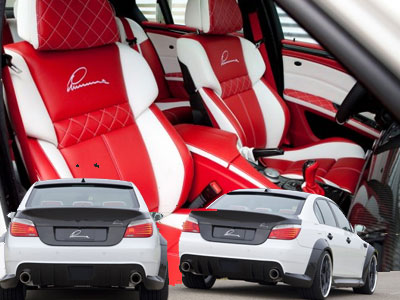
2009 Lumma CLR 730 RS based on the BMW M5 E60 One of the Fastest Sports Car Limousine worldwide.2

2009 Lumma CLR 730 RS


2009 Lumma CLR 730 RS, One of the fastest limousine worldwide, With a unique combination of High Tech engineering and an innovative, solely for maximum power constructed design, LUMMA Design introduces, in cooperation with G-Power. Do you need a true-bred sports car for a spectacular appearance? By no means! With this unique sports limousine CLR 730 RS LUMMA Design, basic vehicle BMW M5 E60, benches many sport cars. Ten cylinders, bi compressor engine, 730 hp and 700 Nm. Is there any room for improvement? Definitely not! The new LCR 730 RS from LUMMA Design is a commitment to racing. But also concerning style and luxury the CLR 730 RS goes strong.
2009 Lumma CLR 730 RS

Aerodynamics is of elementary importance to get a more then 360 km/h maximum speed. The body of the BMW M5 is improved with ultra light but extremely compact carbon components. The LUMMA Bodykit "CLR 730 RS" consist of a hood, a trunk lid with integrated tearing edge, mirror caps, door handles, entrance strips and fenders - all made of carbon.
Extra light and forged wheels were produced for the ultra broad track. On the front axle are LUMMA Racing rims in 10x21" with tires size 255/30-21, on the rear axle 12Jx21 with tires from Michelin size 295/25-21. The wheelwork is three piece crafted, the rim star is forged, and dull black anodized and has stainless steel outer rims.

2009 Lumma CLR 730 RS

The combination of lightweight, enormous engine power and innovative aerodynamics the LUMMA CLR 730 RS from Winterlingen achieves acceleration times which were so far only subject to true race cars. The 730 hp V10 bi-compressor engine obstructed from G-power is the most powerful engine that has ever been obstructed into a road-legal BMW. Off the top off one's head the car catapults itself within 4.2 seconds up to speed 100. After 10 seconds the sport limousine has already doubled the speed. After 29.5 seconds the car achieves 300 km/h. Top speed is at 367,4 km/h. This power explosion is traced back to the core of the G-Power compressor system, the ASA radial compressor. Also used is a LUMMA sport exhaust system with 100 cells racing catalysts and 105 mm end pipes made of stainless steel and engraved LUMMA logo.
2009 Lumma CLR 730 RS

The LUMMA Bodykit “CLR 730 RS” consist of a hood, a trunk lid with integrated tearing edge, mirror caps, door handles, entrance strips and fenders – all made of carbon. The Lumma CLR 730 RS sport suspension is multiple adjustable on both axles in bound and rebound and lowering the car up to 45 mm. On the front axle are LUMMA Racing rims in 10×21″ with tires size 255/30-21, on the rear axle 12Jx21 with tires from Michelin size 295/25-21.

Shelby GT500KR Ford Mustang Sports Car (King of the Road)


Shelby GT500KR Ford Mustang Sports Car

King of the Road
The 2008 Ford Mustang Shelby GT500KR is a limited edition performance model limited to just 1000 units. The launch of the GT500KR at the 2007 New York International Auto Show was designed to coincide with the 40th anniversary of the original 1968 Shelby GT500KR.
The bulging vented hood, styled after the original, is secured by a pair of stainless steel, twist-down hood pins. The composite front valance houses a pair of chrome-trimmed, functional brake ducts to cool the large 14-inch, vented Brembo front brakes.
The Ford SVT-engineered 5.4-liter supercharged V-8 under the GT500KR's hood is treated to a Ford Racing Power Upgrade Pack that boosts horsepower to an estimated 540 and torque to 510 ft-lbs, thanks to revised ignition and throttle calibration and a cold air intake system that replaces the stock unit.
Shelby GT500KR Ford Mustang Sports Car

Power is delivered to the rear wheels of the GT500KR through a Tremec TR6060 six-speed manual transmission and 3.73:1 rear axle ratio, upgraded from the standard GT500's 3.31:1. Gear selection is courtesy of an all-new Ford Racing short-throw shifter making its debut on the KR. Topped with a white ball, the new shifter is 25 percent shorter than the unit on the GT500 providing for crisper, sharper shifts.
Ford SVT, Ford Racing and Team Shelby worked together to develop the GT500KR's suspension tuning. Based on initial work by Ford Racing and the team at Shelby, often at Shelby's own facility on the grounds of Las Vegas Motor Speedway, Ford SVT chassis engineers will apply fine tuning techniques to prepare it for the streets. The Shelby GT500KR will feature unique spring rates, dampers, stabilizer bars, and strut tower brace, all designed specifically for the KR, to deliver the precision handling package.

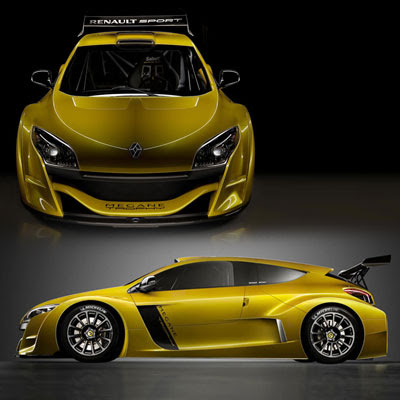
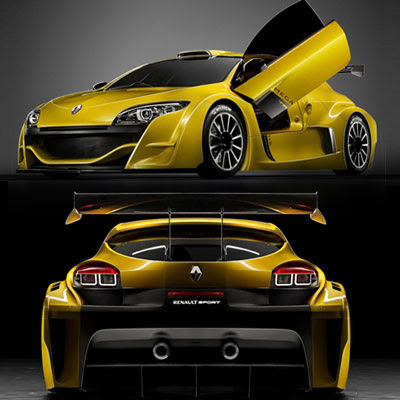
2009 Sport Car Renault Megane Trophy

The 2009 Megane Trophy will go on sale at the end of the year in the form of kit after the completion of its development programme which will enable existing cars to be upgraded.
The 2009 Renault Megane Trophy is based on the new Megane Coupe which is powered by the Renault-Nissan Alliance’s mid-rear 3.5-liter V6 24V engine that produces 360 hp.
The front and rear light units and windscreen are from the Megane Coupe road car while flowing lines of the bodywork was designed from digital simulation technology to improve the aerodynamic.
The Renault Megane Trophy features front splitter which channel air flow to the extractors and rear diffuser and wing that generated downforce. Downforce has improved by 20 % with the refinements to the set-up and drag was reduced by 15 % , which together, represent a gain of almost 40% in terms of the new car’s aerodynamic performance over the previous generation vehicle.

Apart from that, the Megane Trophy also features butterfly doors reminiscent of the world of GT and sports-prototype racing. The V6 3.5 24V engine is mated to a semi-automatic gearbox with the same mechanical features as the current car, including an FIA-homologated sports-prototype tubular chassis, steering wheel-mounted paddle shift, double wishbone suspension with adjustable dampers, 18-inch wheels and Michelin tires.
The power of the standard 330 hp engine was boosted to 360 hp with the help from the new inlet manifold. Rebuild is still at every 5,500 km for the car’s reliability. According to Renault, with the new aerodynamic gains, the extra power from the engine will enable the 2009 Renault Megane Trophy to lap in similar times to those of a Porsche GT3.

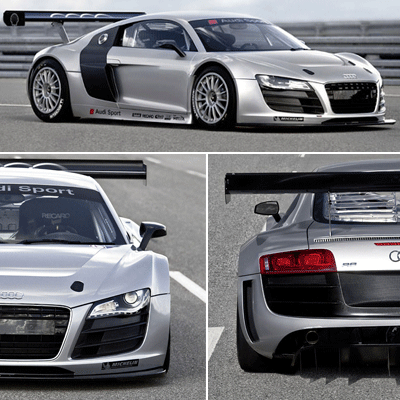
2009 Sport Car Audi R8 GT3


Audi Sport will offer a racing sports car specifically developed for customer use in the form of the powerful 500 hp plus GT3 version of the Audi R8 which will be available from autumn 2009. The logistics and factory space required for the AUDI AG customer programme will be created over the next few months in Ingolstadt, Neckarsulm and Györ.
The Audi R8 conforms to the production-based GT3 regulations allowing the car to be fielded in numerous national and international race series.
Because the GT3 regulations prohibit the use of four-wheel drive the Audi R8 comes with the typical GT rear-wheel drive. The power is transmitted via a newly developed six-speed sequential sports gearbox. The suspension uses almost exclusively components from the production line. A comprehensive list of safety equipment guarantees the highest-level of passive safety. A modified front end and a large rear-wing generate the required downforce for the race track.
The Audi R8, which bears the project name “R16” within Audi Sport, was developed under the direction of Audi Sport. Mid August, the first prototype successfully completed a roll-out in the hands of Audi factory driver Frank Biela.